
Subcutaneous site selection
NAD Injection Sites
Common subcutaneous injection areas contain a layer of fatty tissue beneath the skin. Your provider should identify which sites are appropriate for your prescription and demonstrate proper rotation.
Explore Provider-Guided Treatment
Commonly used areas
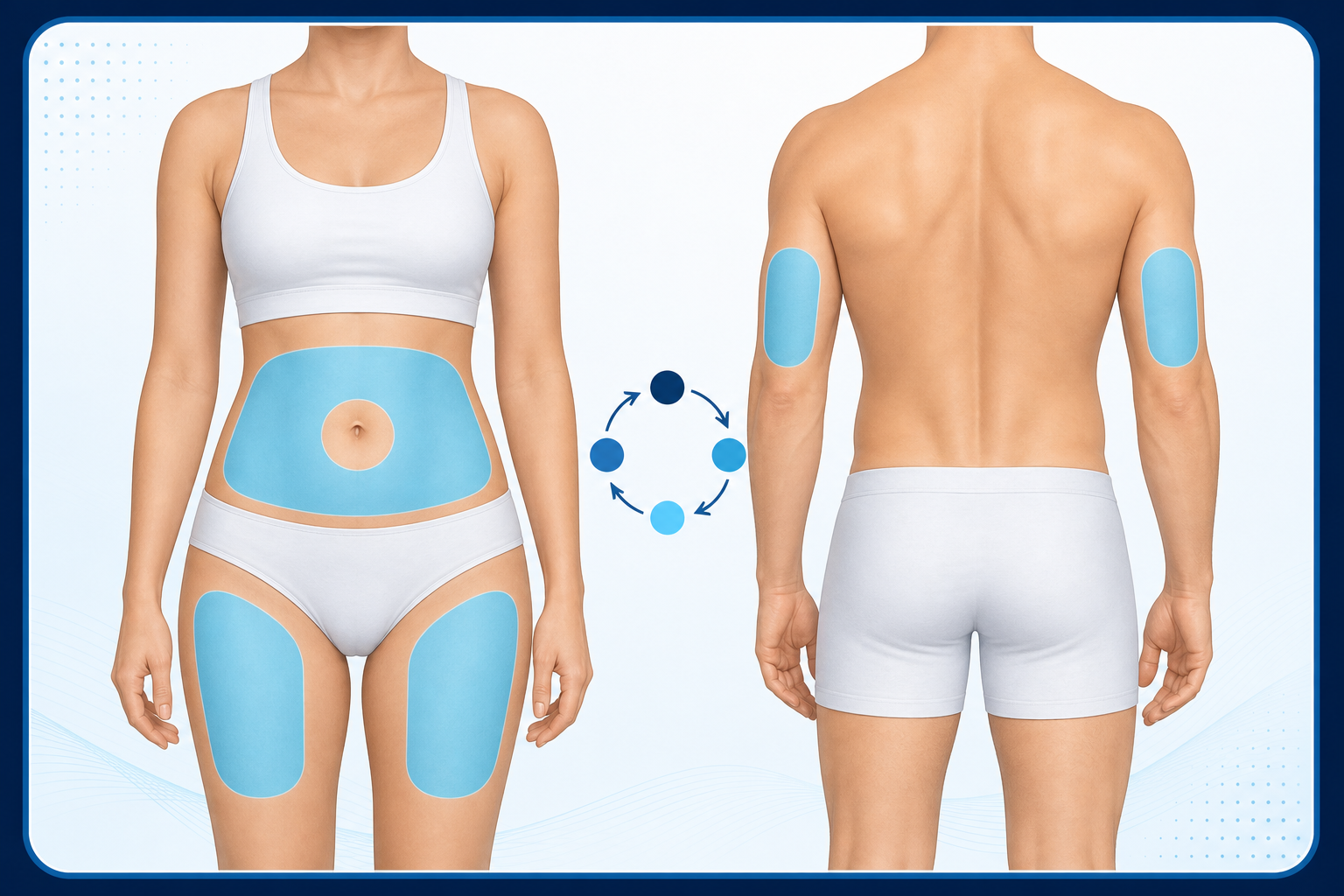
Where subcutaneous injections may be given
Abdomen
The abdomen is commonly used for subcutaneous injections. Follow the provider’s spacing instructions and avoid the immediate area around the navel.
Front or outer thigh
The fatty area of the thigh may be used when approved by the provider. Avoid areas that are unusually tender, bruised, or irritated.
Back of the upper arm
This area can be difficult to reach accurately without assistance. Use it only when the provider confirms it is appropriate and technique is clear.
Other provider-approved areas
Some treatment instructions may identify another fatty area. Do not improvise an injection site that was not included in your guidance.
Injection-site rotation visual
Common subcutaneous regions at a glance
Site rotation
Avoid repeatedly injecting the same spot
Rotation gives tissue time to recover and may reduce repeated irritation, tenderness, bruising, or changes beneath the skin. Keep a simple record if it helps you alternate locations consistently.
Do not inject into skin that is infected, swollen, scarred, hardened, bruised, painful, or otherwise abnormal unless a clinician specifically directs you.
Choosing an appropriate area
Subcutaneous sites need accessible fatty tissue
The best injection area is one your provider has approved and you can reach while maintaining the demonstrated technique. Body shape, mobility, skin condition, and the ability to see the syringe can affect which area is practical. Do not choose a site solely because another person uses it.
Specific spacing instructions—such as how far to remain from the navel, knee, or another landmark—should come from the provider. Follow those measurements rather than estimating from an illustration. For the full preparation sequence, see the subcutaneous NAD injection guide.
Inspect first
Look for bruising, rash, swelling, cuts, tenderness, firmness, or changes from a recent injection.
Use adequate spacing
Follow the provider’s directions for distance from the previous spot and from anatomical landmarks.
Stay within approved areas
Do not switch to muscle, a vein, or an unapproved body area because a usual site feels inconvenient.
Ask about accessibility
If an area is difficult to reach or see, ask whether another approved site is more suitable.
A practical rotation plan
Move systematically instead of choosing randomly
A rotation plan can divide an approved area into zones and move to a different zone with each administration. Another approach is alternating between two provider-approved areas. The goal is to avoid repeatedly puncturing the same small patch of tissue.
Write down the date and general location if memory is unreliable. Do not inject directly into a tender lump or hardened area from a prior administration. If changes persist, pause use of that area and contact the provider.
Frequency affects how quickly sites are reused. Follow the issued schedule and review how often NAD injections are taken before making any change.
Normal irritation versus a concern
Monitor how the area changes
A small amount of temporary discomfort, redness, or bruising can occur with a subcutaneous injection. Track whether it improves rather than expands. Increasing pain, spreading redness, warmth, drainage, fever, substantial swelling, skin discoloration, or a persistent hard area should be discussed with a clinician.
Technique, repeated site use, skin sensitivity, and the medication itself can influence local reactions. Do not assume every reaction is caused by the location alone. Read the NAD injection side effects guide and tell the provider what was injected, when it occurred, and where the site was located.
Seek urgent medical help for trouble breathing, facial or throat swelling, fainting, chest pain, or signs of a serious allergic reaction. Do not wait for a routine online response in an emergency.
Keep the routine consistent
Site selection is one part of safe at-home use
Correct storage, an accurate prescribed volume, clean preparation, single-use equipment, and sharps disposal matter alongside site rotation. A good online treatment program should provide written instructions and a contact for questions after delivery.
Review the NAD injection storage guide before using a delivered vial and the dosage guide before interpreting label measurements. If you are evaluating treatment access, our online NAD injection guide explains medical intake, pharmacy fulfillment, and at-home support.
Special site considerations
Recent procedures and skin changes require guidance
Ask the treating provider before injecting near a surgical area, tattoo with active irritation, stretch mark, skin condition, medical device, or area affected by reduced sensation or circulation. Even when an area normally contains subcutaneous tissue, a personal medical factor may make it unsuitable.
If you cannot comfortably pinch, see, or reach an approved area using the taught technique, do not force an awkward angle. Request another approved option or additional instruction. Assistance from another person should occur only when the provider has explained whether and how that person may help.
Site selection does not change the prescribed amount. Never use a different location as a reason to adjust the syringe volume or schedule. Confirm those numbers in the current directions and contact the provider if the treatment routine is difficult to maintain.
Injection-site questions
Choosing and rotating a subcutaneous site
What is the best place to inject NAD?
There is no universally best site. Use only a region approved in your instructions and choose healthy fatty tissue that you can reach safely.
How far should I move each injection?
Follow the spacing and rotation directions supplied by the clinical team. Avoid repeatedly using the same exact point.
Should I inject into a sore area?
Avoid skin that is painful, bruised, scarred, swollen, infected, or otherwise abnormal unless the provider directs you differently.
What if an NAD injection burns?
Temporary discomfort may occur, but severe, increasing, or persistent burning should be reported. Review our side-effects guide.
Provider-guided treatment
Receive site and rotation instructions
Approved treatment should include clear directions for administration and a clinical contact for questions.
Visit Embody NAD