
Medication handling
NAD Injection Storage Guide
Storage requirements can vary by formulation and pharmacy. The label and pharmacy instructions supplied with your vial always take priority over general advice online.
Explore Provider-Guided Treatment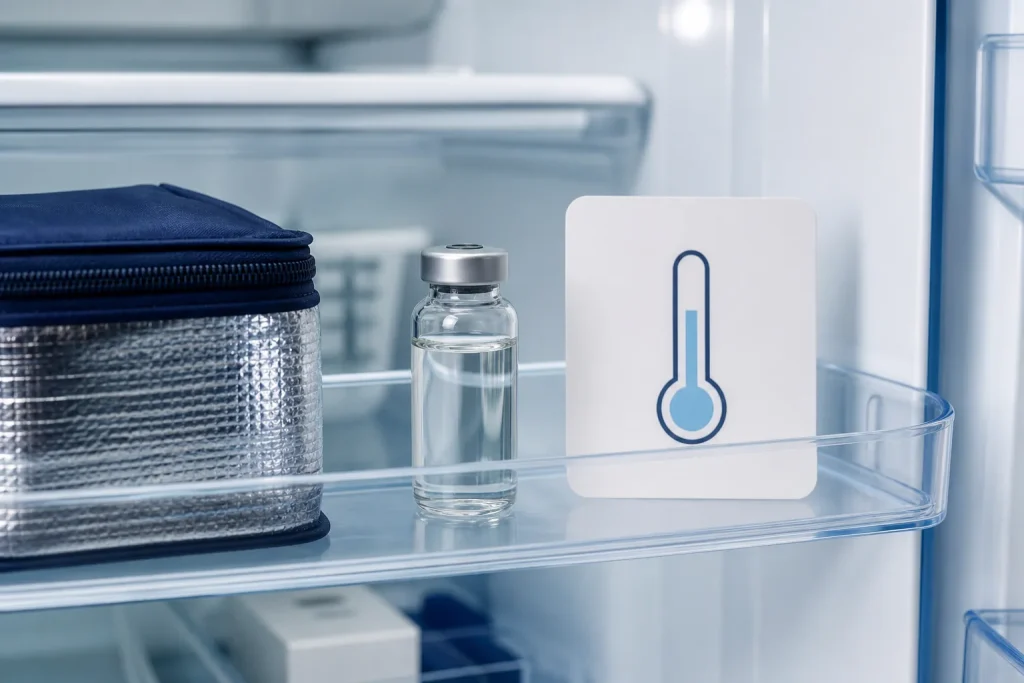
Protect the prescription
Four storage details to confirm
Temperature
Check whether the vial must be refrigerated and what temperature range applies. Do not freeze medication unless the pharmacy explicitly instructs you to do so.
Light exposure
Keep the vial in its original packaging when directed and protect it from prolonged direct sunlight or other intense light.
Beyond-use date
Compounded prescriptions may carry a beyond-use date. Do not rely on appearance alone to decide whether an older vial remains suitable.
Clean storage
Keep medication secured, upright when instructed, away from children, and separate from food spills or areas where the vial may be damaged.
Travel and delivery
Plan for temperature control
Review shipping materials promptly and follow the provider’s instructions if a package arrives warm, damaged, leaking, late, or with melted cooling materials. Do not guess whether temperature-exposed medication is still acceptable.
Before travel, ask the pharmacy about insulated transport, allowable time outside refrigeration, airport screening, and what to do if the vial freezes or becomes too warm.
Start with the dispensing label
Storage rules can differ between prescriptions
Compounded NAD injection formulations are prepared and labeled for a specific prescription. Temperature range, protection from light, handling after first use, and the beyond-use date can differ by pharmacy and formulation. General online advice cannot override those patient-specific directions.
Keep the medication in its original labeled container and packaging unless the pharmacy tells you otherwise. Do not transfer it to an unlabeled container. Store it separately from food spills and high-traffic refrigerator areas where it could be dropped, contaminated, or left out.
Refrigeration
Use the labeled temperature range and avoid placing the vial against cooling elements where accidental freezing can occur.
Room-temperature exposure
Ask how long the product may remain outside refrigeration; do not create your own allowable time.
Freezing
If the vial may have frozen, quarantine it and ask the pharmacy whether it must be replaced.
Light and moisture
Retain protective packaging and keep the vial away from direct sunlight, heat, and damp storage areas.
When the shipment arrives
Inspect the package before putting it away
Open temperature-sensitive deliveries promptly. Confirm the patient name, medication, concentration, vial condition, directions, and included supplies. Cooling materials may no longer be frozen when a package arrives, but only the pharmacy can determine whether the medication experienced unacceptable exposure.
Take note of a damaged box, broken seal, leaking vial, missing label, unexpected appearance, or significant delivery delay. Keep the packaging while you contact the provider or dispensing pharmacy. Do not inject first and ask later.
For the wider fulfillment process, see NAD injections at home and our guide to buying NAD injections online.
Before every administration
Check the vial, date, and storage history
Inspect the medication in good light and compare it with the pharmacy’s description. Do not use it if the vial is cracked, leaking, unsealed, past its labeled date, unexpectedly cloudy, discolored, contains unanticipated particles, or may have been stored incorrectly. A normal appearance does not prove that temperature-exposed medication is safe.
Clean and handle the vial only as instructed. Return it to storage promptly after preparation. The subcutaneous injection guide covers the surrounding preparation routine, and the dosage guide explains why every refill’s concentration and directions must be checked again.
Traveling with NAD injections
Plan before leaving home
Ask the pharmacy how to maintain the required temperature during the entire trip, which insulated materials are appropriate, and how long the medication may remain in transit. Avoid direct contact between the vial and frozen packs unless instructed, because accidental freezing may damage the product.
Keep the labeled prescription with you and check current transportation rules for medication, needles, and sharps containers. Do not place temperature-sensitive medication in checked baggage where temperature and access are uncertain. At your destination, confirm appropriate storage before the vial warms.
If a delay, power outage, refrigerator failure, or travel problem creates uncertainty, isolate the vial and call the pharmacy. Do not rely on smell, appearance, or an internet post to approve continued use. Review NAD injection safety for other factors that support responsible at-home treatment.
Power outages and refrigerator problems
Document the exposure instead of guessing
If refrigeration is interrupted, keep the refrigerator closed when practical and note when the outage or equipment problem began. Record the highest known temperature and the approximate duration if that information is available. Do not freeze the vial in an attempt to cool it quickly.
Contact the dispensing pharmacy with the exact product, concentration, storage history, and current vial condition. The pharmacy can determine whether its formulation remains usable or requires replacement. Different compounded products may not have the same stability information.
Store medication where other household members understand that it must not be moved or discarded casually. Keep pharmacy contact details with the prescription so a storage question can be resolved quickly. When there is uncertainty, waiting for qualified guidance is safer than using a vial whose integrity cannot be confirmed.
Common storage questions
Refrigeration, travel, and temperature exposure
Does NAD need to be refrigerated?
Requirements can differ by formulation and pharmacy. Follow the temperature range on your current vial label and contact the pharmacy when it is unclear.
Can NAD injections be frozen?
Do not freeze the vial unless the pharmacy explicitly instructs you to do so. Contact the pharmacy if freezing may have occurred.
How should I travel with NAD injections?
Ask the pharmacy about transport temperature, packaging, security, and time away from refrigeration before the trip. Keep the labeled prescription with you.
What if the shipment arrived warm?
Document the condition and contact the dispensing pharmacy before use. Do not assume that appearance alone confirms safety.
For legitimate online access with labeled fulfillment, review how to buy NAD injections online and our Embody NAD review.
Provider-guided treatment
Get medication with clear handling instructions
Embody provides prescribed treatment and guidance for approved patients using NAD injections at home.
Visit Embody NAD